
Ceph Storage Clusters
Experience seamless exabyte-level cloud storage without a single point of failure. Our fully distributed architecture, powered by Ceph on specialized hardware, ensures unmatched reliability and flexibility.
- Use NVMe drives as fast storage or as a caching layer for spinners
- Replicate an existing Ceph cluster for data recovery
- Replicate cluster out to another OpenMetal cloud or any Ceph cluster
- Provisioned with a recent stable Ceph release
- S3-compatible APIs that integrate with AWS S3 tools
Open Source Object Storage With Ceph
Build large-scale Ceph storage clusters using our validated configurations and tested hardware
Ceph is an open source software-defined storage platform that enables cloud computing environments to store and manage data on a distributed basis. Ceph is designed to provide highly reliable, scalable, and cost-effective storage solutions for organizations of any size. It can be used for both private and public clouds, as well as traditional IT environments.
Ceph provides a unified storage layer that allows users to store data in the most efficient way possible while keeping costs low. With Ceph's advanced features such as data replication, snapshots, erasure coding, and compression, organizations can ensure their data is secure and always available. Additionally, Ceph provides S3-compatible APIs, which means it can mimic the functionality of Amazon S3 and integrate with tools that use S3 storage.
If you're looking for disk space intensive storage needs like large scale S3 compatible object storage, OpenMetal's Ceph Storage Clusters are ideal.
Storage Cluster Pricing»Ceph Storage Cluster Use Cases
Big Data
Ceph can efficiently handle large data sets created by big data analytics projects. Its distributed architecture and parallel processing capabilities help accelerate data analysis tasks, and its built-in redundancy ensures data reliability, which is critical for big data analytics.
High Performance Computing
Ceph can manage massive datasets included in scientific simulations thanks to its distributed file system capabilities and robust performance. Additionally, Ceph's efficient storage and management capabilities make it an ideal choice for storing and processing the large datasets required by ML and AI models.
Cloud Storage
Ceph storage clusters are a flexible and open source alternative to traditional cloud storage solutions like AWS S3. Its horizontal scalability allows for elasticity to meet growing data demands, while its object-based storage model aligns seamlessly with cloud-native applications.
Cloud Integrated or Bare Metal Integrated
While our Ceph Storage Clusters can be purchased independently, our customers often integrate them into broader infrastructure solutions, including hosted private clouds and dedicated bare metal servers.
Cloud Integrated
- Unified Management: Both Ceph and OpenStack can be managed from a single interface, simplifying operations.
- Flexibility: OpenStack offers a flexible platform for various workloads, including compute, network, and storage.
- Integration: Ceph and OpenStack are designed to work together seamlessly, providing a cohesive solution.
Bare Metal Integrated
- Performance: Bare metal dedicated servers offer maximum performance and control.
- Simplicity: Managing bare metal servers is generally simpler than managing a cloud platform.
- Cost-Effectiveness: Bare metal can be cost-effective for specific workloads, especially those requiring high performance and predictable costs.
“I would definitely recommend OpenMetal. The key points would be an excellent support staff with deep knowledge and troubleshooting steps that are relevant to the issue and don't begin with the basics. In addition, we have had very minimal downtime issues and our site performance has improved since we started using OpenMetal.”Learn More
Arys Andreou, Head of Infrastructure
& Matt Weston, CFO

Strategic Data Center Locations
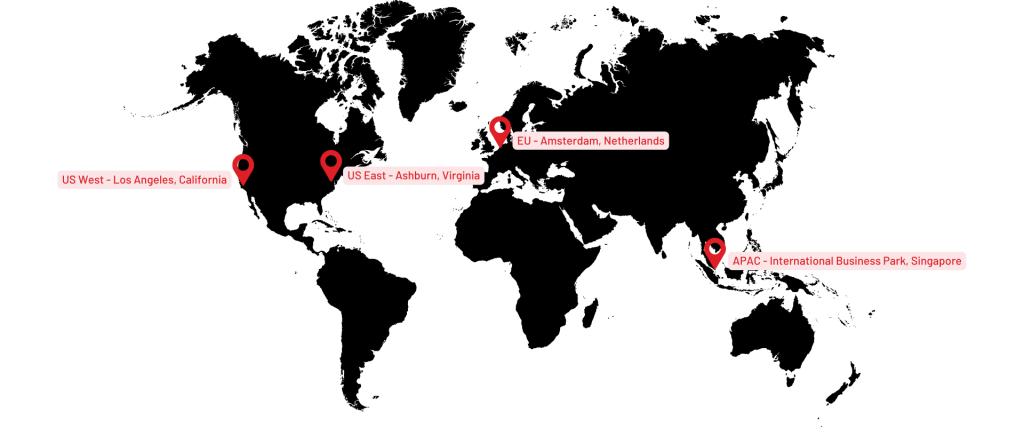
All our servers are strategically located in Tier III data centers, with two in the United States, one in the Netherlands, and one in Singapore. Our data centers:
- Support compliance with various federal regulations and industry standards
- Are located near a high concentration of IT, telecommunications, biotechnology, federal government, and international organizations
- Provide multiple layers of redundancy
- Are ISO 27001 certified to provide additional data security and privacy
Contact OpenMetal Sales Team
Schedule a Consultation
Get a deeper assessment and discuss your unique requirements.
Schedule ConsultationYou can also reach our team at sales@openmetal.io
Ceph Storage Cluster FAQ
What is Ceph object storage?
Ceph provides the network storage including block storage, object storage, and if needed, NFS-compatible file storage called CephFS. All OpenMetal clouds come with Ceph-based block and object storage supplied by the private Cloud Core.
How do I get help with Ceph?
Our included onboarding process will get you out and using your Ceph storage cluster. We also offer optional long term assisted management if needed. For complex alterations to our standard deployment we may assist, for a fee, or connect you with an accredited Ceph professional in our network.
How does Ceph work when hyper-converged with OpenStack on a Cloud Core?
Your Ceph employs five distinct daemons that are all fully distributed and run alongside OpenStack and your VM workloads. A calculated amount of resources have been set aside for your Ceph including your object gateways, Ceph monitors and Ceph OSDs. Health monitoring software (Datadog) is also included in your deployment and can help pinpoint if there is any contention once a cloud gets near to capacity.
Can I use the boot drive for data storage or part of a Ceph pool?
No, this is not recommended unless it is an emergency or a similar temporary situation. Those drives are not intended for heavy use and are not rated for high disk writes per day. Additionally, they are in use by the cluster management software and operating system already.
For Ceph data redundancy, why choose 3 replicas versus 2 replicas or vice-versa?
Three replicas provide stronger data durability and availability — your cluster can tolerate two simultaneous failures without data loss. Two replicas reduce storage overhead (you use 2x raw capacity instead of 3x) and may be suitable for less critical workloads or when budget constraints are a priority. OpenMetal's team can help you evaluate the right replication factor for your specific use case.
Ready to Get Started?
Deploy scalable, S3-compatible Ceph storage clusters on dedicated hardware with root-level access and expert support.